

Everything I Ever Thought About Plot is Wrong
What plot is NOT

[Update: This is part 1 of a two part series. Read part 2, “What plot IS” here]
Something has started to drive me crazy, and it’s that I don’t think anyone agrees on what we mean when we say the word “plot” and so our conversations about it are almost always useless.
I’ve noticed that people say “plot” when what they actually mean is “action,” “incident,” “narrative,” “story,” “structure,” “situation” or “premise.” No doubt I’ve become a little obsessed with the word because I just finished teaching a semester-long course on it in the Temple University Creative Writing MFA program (deadline 2/15 btw!) but I’ve also written before about how I began to question the idea, received and passed on by so many of us, that plot in a piece of fiction is what happens in the external, observable universe and then what happens next.
In that post, I wrote about thirty books I’d read recently that had plots that worked for me grouped into categories based on how and why I thought they worked — “plot as the character in tension with herself,” “plot as denied feeling rising to the surface,” “plot as POV trouble,” were a few of them. Incident and its consequences were one kind of plot grouping, yes, but it was just one possibility out of five. “I think on some fundamental level plot is just what keeps the reader inside the book rather than say, texting, or watching Selling Sunset, or taking a nap,” I wrote almost exactly two years ago (fucking A, time passes!), and I mostly stand by that today. A year ago, I also interviewed the master of the literary mystery, Liz Moore, on what plot is to her. She said it is “a big unanswered question that has to be answered by the end of the book.”
My graduate students at Temple this past fall rocked, and over the course of the class so much of what I thought about plot changed again (I’ll get to the specifics in a sec, though this will be part 1 of a two parter). Then one day recently, I was standing in a coffee shop in Williamstown, Massachusetts getting breakfast before the wedding I was visiting town for, and a copy of the novel The Plot by Jean Hanff Korelitz was sitting on a shelf in the coffee shop for free. NYTimes bestseller. Bland cover to match, though with slight hint of metafiction. Huh, I thought, and snatched it up.
Spoiler: I did not love that novel, though I did gobble it up pleasantly at night before bed. But the point is, it turned out to be extremely generative for my thinking on plot because the premise of that novel is as follows: The main character, a washed up writer (eek!) meets a student at a graduate writing MFA program (double eek!) and the student has a novel in progress that has, and I quote, “a foolproof plot.” The plot is so good, says this student, that “no matter how lousy a writer, no one could mess it up.” Later in the novel, another verbatim quote: “I just care about the story. Either it’s a good plot or it isn’t. And if it’s not a good plot, the best writing isn’t going to help. And if it is, the worst writing isn’t going to hurt it.”
According to this character, and then to the invented public within the world of the novel, a book’s “plot” can be stolen. Jean Hanff Korelitz herself may or may not agree with public opinion within the fictional world she’s created (probably not, since the meaning of authorship and “plagiarism” are at direct issue in the book) but the novel points towards a big truth I sort of knew but which whacked me over the head nonetheless: average Americans believe that a premise or situation or event lifted out of one work of art and put in an entirely different work of art, dreamed up and written by an entirely different human, will maintain its integrity, aka be the same plot.
I just do not think this is, in any meaningful way, true. If it were, this would be such a warped and limiting definition of plot. However, this is the definition that many of us use, and it is, in my opinion, both warping our minds and limiting the conversations we can have about good fiction.
**A caveat here: I am writing about plot as a craft issue from the writer’s perspective, not about plot as a sales/commerce/capitalism issue from the agent or editor or marketer or publicist’s perspective.**
I also just fundamentally do not believe that a premise and its consequences is the only way to create a plot. I can call to mind many very propulsive novels that fully captivate us with their spell in which the main reason I am reading is truly not “what is going to happen?” I can think of these just from glancing at my bookshelf — How Should A Person Be by Sheila Heti, The Pisces by Melissa Broder, Audition by Katie Kitamura, The Salt Eaters by Toni Cade Bambara, Women Talking by Miriam Toews, Breasts and Eggs by Mieko Kawakami, Exist Ghost by Philip Roth — but the list goes on and on. Yet I would go to the mat to argue that any of the books I just listed have a plot.
A similar conceptual re-framing is suggested in this recent interview of fiction writer Ayşegül Savaş by Catherine Lacey. “Very little happens in your novels,” Lacey says to Savaş, “your most recent one, The Anthropologists might have the least plot of all, and yet it was a break-out book of 2024, hugely beloved.” A little later, Savaş says, “I’ve also learned that faking plot is much worse than not writing it in the first place. Editors who want to force plot onto books whose structure and texture won’t allow it, should know that the outcome will be disappointing for everyone. Neither plot-driven nor plotless readers will be satisfied. My current inclination, when asked for more story, is actually to remove any false promises.”
I love this answer, though both interviewer and interviewee are using the mainstream definition of plot as “happening”, because it points the way towards a larger definition of plot as what makes a book tick — I read the idea of removing “false promises” here as a writer who is drawn to using a different kind of plot going back into a draft and removing half-hearted gestures towards conventional incident-as-plot in order to more fully commit to the book’s true logic.
On this train of thought, I want to give credit to Lincoln Michel who wrote an essay for LitHub called “On the Many Different Engines that Power a Short Story” that helped me connect some dots. “I’m interested in what devices—engines let’s call them, since surely the author is always the driver…can supply power to the rest of story,” Michel writes. “What interests me in thinking of stories as powered by different engines,” he writes, “is that it emphasizes that the same stories can be told in different ways based on what is powering them.” The same story you say? Told with different engines? It’s almost as if, then, a “story” told with a different logic or engine, is not the same “plot” afterall.
Without further adieu, here is my list of all the things I think today that “plot” is NOT:
Plot is not just incidents and the things that flow from them by cause and effect. If that were true, novels would just be lists of events that happened and triggered other events.
Plot is not the same as story. From John Truby, The Anatomy of Story: “Story is much larger than plot. Story is all of the subsystems of the story body working together: premise, character, moral argument, world, symbol, plot, scene, and dialogue.” We’ll unpack Truby next time, don’t worry.
Plot is not the same as premise. See above.
Plot is not an independent craft element. It cannot be lifted out of a book and stolen. It is inextricably intertwined with every other element of writing fiction — point of view, language, voice, character development, duration, pacing, balance of scene vs. exposition, and on and on. Pull on, or change any one of these other elements, and you alter, also, in my view, the “plot.” How many novels do we see that have the same basic premise and incidents — woman hates her husband and wants to get a divorce; woman wants to get out of town and make something of her life; woman falls in love then goes missing — but use fundamentally different logics (or “engines” to use Michel’s parlance) to tell their story? So many. (Don’t even get me started on books like The Seven Basic Plots)
OK, do get me started. Plot is not the same as theme or myth type. That is better studied by folklorists, mythologists, and sociologists and is none of my business.
Plot is not just suspense. Suspense is suspense. See Patricia Highsmith’s sort of dated and wacky but useful book Plotting and Writing Suspense Fiction.
Plot is not just tragedy. Put another way, as Courtney Maum says, “a bummer is not a plot.” Trauma is also not a plot.
Plot is not the same as conflict, nor does it always need conflict. See my past post about Ocean Vuong’s use of the Japanese narrative form Kishotenketsu.
Plot is not just multiple points of view. As much as many of us are trying to make it so!!!!
A few other quotes I like that *feel* related to what plot is NOT, from talks both authors gave at Breadloaf:
“In the midst of all the explaining there is something left unexplained which will be at the center of the plot.” — Alexander Chee
“The fight between you and the story you are trying to tell provides an essential clue to your plot. I’ve never solved a problem I’ve had with writing a novel by writing around that thing, I’ve only solved the problem by making the novel about that thing.” — Rebecca Makkai
Ah!!!
I’ll be back next month on March 8 with the second part of this two parter “Everything I Thought About Plot Is Wrong” series and that one will be called “What Plot IS.” If you just can’t wait, I made this list of every definition of plot from every craft essay and every piece of narrative theory (Matthew Salesses! George Saunders! Northrop Frye! Kelly Link! John Barth! John Gardner! Jane Alison!) my graduate students and I looked at. The list is available for paid subscribers of Frump Feelings, just request access with the email you use for your paid subscription and you’re in. Til next time!
Toppings
I’m quitting: TikTok. I’m sad, because TT introduced me to so many interesting thinkers and smart literary fiction book reviewers like Tell the Bees & Celine & Nic Marna. But alas, Meg Stalter of Hacks told me to do it (it seems her videos critical of ICE were suppressed by the app) so off I go. I’m tryinggggg to quit Instagram but it’s slow going.
I’m reading: Dear Committee Members by Julie Schumacher. Fun. Written in the form of a series of letters of recommendation. And The Murder of Roger Ackroyd by Agatha Christie. Also fun — Christie at her best and most craft experimental. Cozy murder!
I’m listening to: Monogamy by Sue Miller on audio, performed by the author (rare for fiction!). It reminds me of the best of Alice Munro (oh Alice, how you broke our hearts with what you did) while being a juicy contemporary novel about marriage and bookish people making bad choices.
I’m watching: Bridgerton Season 4 (“Asian Cinderella!” — my spouse), and the ice dancing documentary.
I’m teaching: a low-cost Zoom class on Writing the Body in fiction on 3/19 and a week long in-person class on short fiction at the McCormack Writing Center in Portland in July (previously the Tin House Summer Workshop).
Book Scoop
My next book, a collection of linked stories called FAT SWIM will be published on April 28th. You can pre-order her wherever books are sold, a little gift from past you to future you, or request her from your local library.
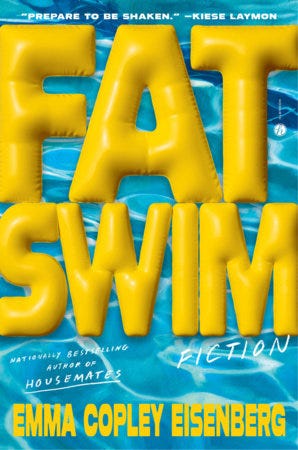
Beautiful print galleys have arrived! If you are a reviewer, podcaster, bookseller, event series organizer, or just general loudmouth and you want one, please reach out to my team here. You can also request an e-galley of the book from NetGalley, enter the Goodreads giveaway, add her to your Goodreads TBR or add her to your Storygraph TBR.
Save the dates for April 30 in Philly & May 13 in Brooklyn, more dates & places TBA. There will be popsicles.
xx
Emma
If you liked this newsletter, feel free to share it with other people, to subscribe to this newsletter as a free or paid supporter, or check out my novel Housemates.
I agree, there is much confusion about what a plot is and it can create resistance around the whole subject of plot, which is actually fascinating. As you have demonstrated here so well. I just read The Anthropologists, which is a perfect book to read to consider what plot might be in a broad definition. Can't wait for Part Two.
This is so helpful and resonant as a big reader and new writer of fiction. Eagerly awaiting part 2!